The working principle of coaxial cable
Jun 03, 2021
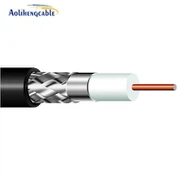
The coaxial cable is divided into four layers from the inside to the outside: the central copper wire (single-strand solid wire or multi-stranded wire), plastic insulator, mesh conductive layer and wire sheath. The central copper wire and the mesh conductive layer form a current loop. It is named because of the coaxial relationship between the central copper wire and the meshed conductive layer.
Coaxial cables conduct alternating current instead of direct current, which means that the direction of the current is reversed several times per second.
If a general wire is used to transmit high-frequency current, this wire will be equivalent to an antenna that emits radio outwards. This effect loses the power of the signal and reduces the strength of the received signal.
The coaxial cable is designed to solve this problem. The radio emitted by the central wire is isolated by the mesh conductive layer, which can be grounded to control the emitted radio.
There is also a problem with coaxial cables. If a certain section of the cable is squeezed or twisted, the distance between the center wire and the mesh conductive layer is not consistent, which will cause the internal radio waves to be affected. Reflect back to the source of the signal. This effect reduces the receivable signal power. In order to overcome this problem, a layer of plastic insulator is added between the center wire and the mesh conductive layer to ensure that the distance between them is consistent. This also causes this kind of cable to be relatively rigid and not easy to bend.
The shielding material of the coaxial cable is essentially the improvement of the outer conductor. From the initial tubular outer conductor, it has been developed into a single-layer braided and double-layered metal. Although the tubular outer conductor has very good shielding performance, it is not easy to bend and inconvenient to use. The shielding efficiency of single-layer braiding is the worst, and the transfer impedance of double-layer braiding is 3 times lower than that of one-layer braiding. It can be seen that the shielding effect of double-layer braiding has been greatly improved compared with single-layer braiding. Major coaxial cable manufacturers are constantly improving the outer conductor structure of the cable to maintain its performance.